
How to Make a Divorce House Sale Less Stressful
A hassle-free house sale during a divorce starts with three agreements: whether to sell, how to set a fair price, and how to divide the proceeds. Check with your divorce attorney for any court limits before signing a contract. Then get a neutral valuation, put both spouses’ decisions in writing, and keep the mortgage paid until the sale closes.
If time or repairs are a concern, an as-is cash sale may cut out showings and repair work. Full Circle Homes buys Jacksonville-area homes as-is, without commissions, and offers a flexible closing date. Both spouses still need to resolve any legal or title issues before closing.

Legal Framework: Protecting Property Rights and Determining Home Value
Navigating the real estate aspects of a separation requires understanding local statutes and courtroom procedures. In Northeast Florida—including Jacksonville, Ponte Vedra Beach, and St. Augustine—property division follows specific state statutes rather than arbitrary decisions.
Under Florida law, assets accumulated during the marriage are categorized as marital property, subject to equitable distribution. This framework does not guarantee an automatic 50/50 mathematical split, but rather a division that the court deems fair based on economic circumstances, the duration of the marriage, and each party’s financial contributions. Conversely, non-marital property (assets acquired prior to the marriage or received via specific individual inheritances) remains separate, provided those assets were not commingled with joint funds or transmuted through joint deed titling.

When navigating this landscape, working with experienced legal counsel is essential. A local family law attorney can help clarify your rights early, keep proceedings amicable, and avoid unnecessary litigation expenses. Knowing your baseline legal rights prevents either party from taking unilateral actions that could violate state statutes or court standing orders, such as those reviewed by the FIRST DISTRICT COURT OF APPEAL STATE OF FLORIDA.
Can You Sell Marital Property During an Active Divorce?
Yes, you can sell real estate while a divorce is actively pending, but you must observe strict legal boundaries. When a petition for dissolution of marriage is filed, local family courts often implement automatic status quo orders or temporary injunctions. These orders prevent either spouse from selling, transferring, encumbering, or dissipating any marital assets without mutual written consent or express judicial authorization.
Attempting to list or liquidate a home without your spouse’s signed authorization is both legally void and financially risky. In Florida, both spouses must execute the closing deed for marital real property, even if only one spouse’s name appears on the underlying mortgage note.
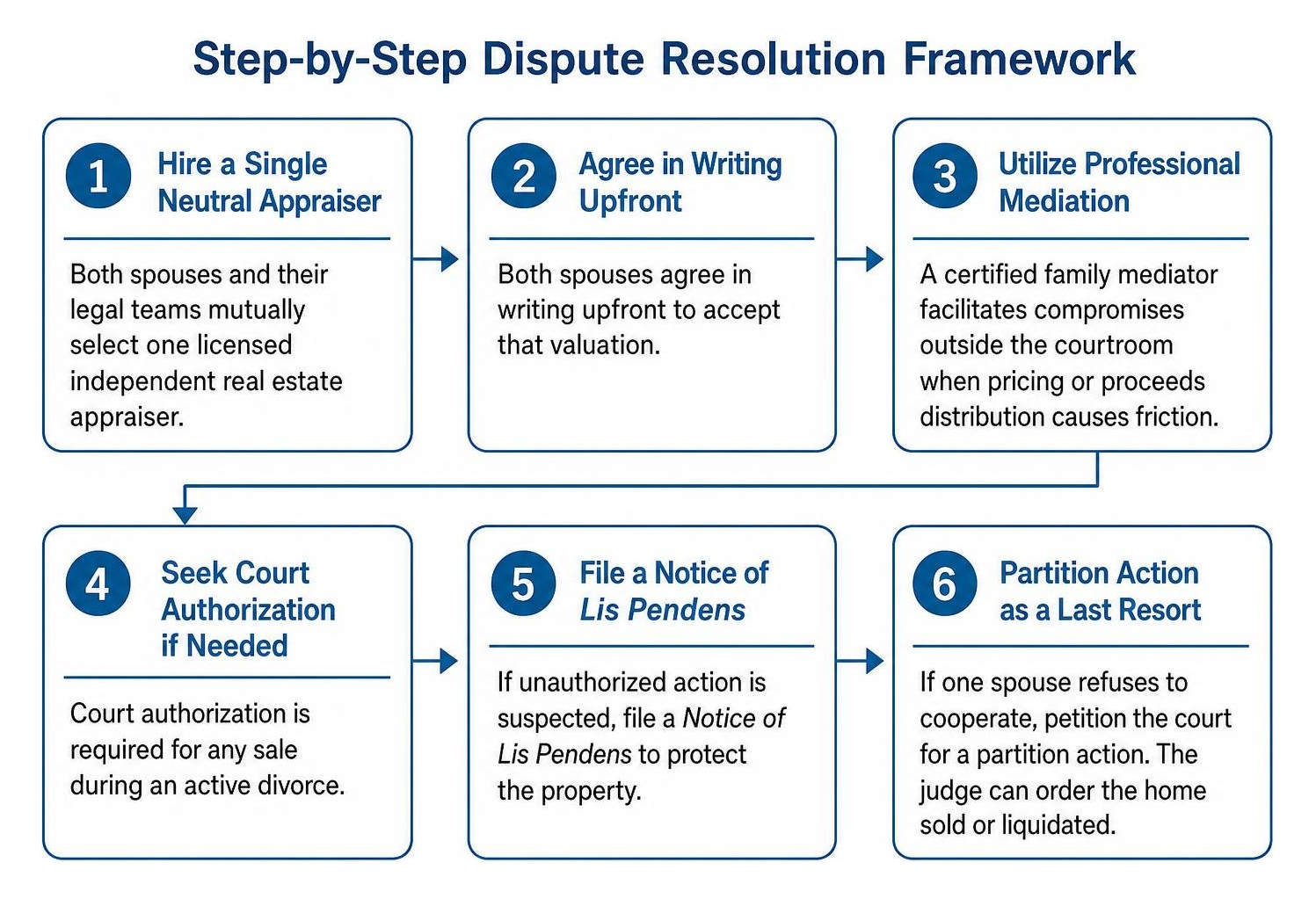
If one party suspects the other is attempting an unauthorized off-market transfer or encumbrance, their attorney can file a formal Notice of Lis Pendens with the county recorder (such as in Duval, St. Johns, or Clay County). This filing puts public cloud on the title, preventing any clear title insurance from being issued to third-party purchasers until the court intervenes.
Resolving Spousal Disputes and Achieving a Divorce House Sale Hassle Free
When emotions run high, setting an agreed-upon listing price or determining property value can quickly turn into a major roadblock. Disputes over property value are among the most common reasons divorce-related real estate transactions stall.
To achieve a divorce house sale hassle free, both parties should remove personal sentiment from the equation by implementing these objective steps:
- Hire a Single Neutral Appraiser: Instead of relying on separate, conflicting property estimates, both spouses and their respective legal teams can mutually select one licensed independent real estate appraiser. Agree in writing upfront to accept that valuation.
- Utilize Professional Mediation: If pricing or proceeds distribution causes friction, a certified family mediator can facilitate compromises outside the courtroom, saving thousands in trial preparation costs.
- Partition Actions as a Last Resort: If one spouse completely refuses to cooperate or communicate reasonably, the other spouse can petition the court for a partition action. Through partition or equitable distribution enforcement, the judge can order the home sold on the open market or directly through court-supervised liquidation.
Evaluating Your Options When Neither Spouse Can Buy Out the Other
A common early ambition in divorce proceedings is for one party to keep the primary home by buying out the other spouse’s equity stake. However, when housing costs rise or a household shifts from dual incomes to two separate single-income budgets, a buyout often proves financially impractical.
Buying out a spouse requires two hurdles: having enough accessible cash or equity to pay off their share, and qualifying independently on a single income to refinance the existing mortgage balance.

If an outright buyout is off the table, holding the property in co-ownership post-divorce is technically possible, but it comes with substantial long-term risks:
- Default Risk: If the occupying party misses mortgage payments, both individuals’ credit ratings suffer severe damage.
- Maintenance Disagreements: Deciding who pays for a failed HVAC system or roof repair routinely sparks secondary litigation.
- Deferred Sales: While a judge might occasionally award temporary exclusive use of the home to the primary custodial parent until children reach adulthood, this defers the ultimate sale and ties up necessary equity for both people.
For most separating couples, selling the property cleanly and dividing the net financial equity is the simplest path to a fresh start. Whether dealing with property locally in Florida or handling interstate asset divisions, liquidating shared real estate eliminates ongoing financial entanglements.
Traditional Listing vs. Selling As-Is to a Direct Buyer
When listing through traditional channels, both owners must coordinate cleaning, open houses, weekend showings, home inspections, repair credits, and retail buyer mortgage contingencies. In a divorce, this requires ongoing communication between two people who are actively trying to separate their lives.
Selling directly to a professional cash home buyer eliminates these friction points. Here is a clear look at how these two paths compare:
| Consideration | Traditional Retail Listing | Direct As-Is Cash Sale |
|---|---|---|
| Preparation & Repairs | Requires deep cleaning, staging, painting, and pre-listing repairs | Sold completely 100% “as-is”; no repairs, updates, or cleaning required |
| Showings & Privacy | Intrusive open houses, lockboxes, and frequent stranger walk-throughs | Private, discrete evaluation with zero public foot traffic |
| Financing Contingencies | High risk of bank appraisal shortfalls or retail loan denials | No financing contingencies; backed by immediate proof of funds |
| Commissions & Fees | 5% to 6% in agent commissions plus standard seller closing fees | Zero commissions, zero agent fees, and buyer covers normal closing costs |
| Closing Timeline | Typically 60 to 90+ days from initial listing to closing table | Rapid closing in as little as 7 to 15 days, or on your preferred timeline |
Managing Stagnant Listings and Delayed Proceedings
A house that lingers on the retail market for months can quietly derail an entire divorce settlement. As long as the home sits unsold, carrying costs accumulate every thirty days:
- Ongoing principal and interest mortgage payments
- Property taxes and homeowners association (HOA) dues
- Hazard insurance premiums and electric/water utilities
- Lawn care and routine maintenance expenses
When market conditions soften, prolonged exposure often leads to consecutive price reductions. If an agreed-upon retail listing does not attract buyers, the financial strain of paying for two separate households while maintaining a vacant marital property can quickly drain marital savings. A direct sale provides certainty, establishing a fixed closing date and an exact net figure to write into your formal marital settlement agreement.
Financial and Tax Implications: Mortgages, Deeds, and Capital Gains
Resolving the physical house is only half the battle; the financial and tax obligations tied to the asset must be handled correctly to avoid long-term liabilities.

Managing Joint Mortgage Debt and Title Transfers
A frequent misconception in family law is that an executed divorce decree assigning the home to one spouse releases the other spouse from the debt. It does not.
A divorce court has jurisdiction over the spouses, but it cannot alter contracts made with independent third-party mortgage lenders. If both names are on the promissory note:
- Both parties remain 100% jointly liable for the entire debt balance.
- Missed or late payments made by your former partner will directly lower your personal credit score.
- The outstanding debt counts toward your debt-to-income (DTI) ratio, limiting your ability to qualify for a new mortgage in Jacksonville Beach, Orange Park, or Atlantic Beach.
To fully remove an individual’s name from a mortgage, the retaining spouse must apply for, qualify for, and close on an independent refinancing loan.
Simultaneously, the departing spouse signs a Quitclaim Deed or Special Warranty Deed conveying their ownership interest. If refinancing cannot be achieved within a strictly mandated timeline, selling the property entirely to pay off the note in full is the safest legal route.
Tax Differences Between Selling Before vs. After Divorce Finalization
Timing the sale of your marital residence can have significant federal tax consequences under IRS Section 121:
- Married Filing Jointly (Selling Before Finalization): Couples who own and have used the home as their principal residence for at least two of the five years preceding the sale can exclude up to $500,000 of capital gains profit from federal capital gains taxes.
- Single Filers (Selling After Finalization): Once the divorce decree is finalized and tax status shifts to single filers, each individual is limited to a maximum exclusion of $250,000.
If your home has built significant equity over decades of ownership, coordinating with your certified public accountant (CPA) and family law attorney to close the transaction prior to legal finalization can protect a substantial portion of your marital net worth.
How a Cash Sale Delivers a Hassle-Free House Sale During a Divorce
When you want to avoid prolonged negotiations and move forward, selling the property directly for cash provides a straightforward alternative to the open market.
Bypassing Showings, Repairs, and Financing Contingencies
In a contentious divorce, simple logistical tasks—such as agreeing on an electrician’s repair estimate or deciding who stays home for a plumbing inspection—can quickly trigger arguments.
A direct cash sale removes these friction points:
- No Pre-Sale Preparation: You do not have to spend marital funds repainting walls, landscaping, replacing aging roofs, or deep cleaning for weekend open houses.
- No Financing Fallout: Because cash transactions do not require underwriting or traditional lender appraisals, there is no risk of a buyer’s loan falling through days before closing.
- Total Discretion: Avoid placing “For Sale” signs in front of your home or publishing photos across national real estate portals.
Structuring a Divorce House Sale Hassle Free for a Fast, Fair Split
At Full Circle Homes, we work with homeowners and their legal teams across Jacksonville, St. Augustine Beach, Fleming Island, Middleburg, Neptune Beach, and Ponte Vedra. We structure sales to provide a straightforward and transparent process for both parties:
- Independent Escrow Handling: We coordinate directly with a neutral, licensed Florida title company or real estate attorney.
- Transparent Closings: All settlement statements reflect full payoff of existing mortgages, county property taxes, and municipal liens.
- Direct Split of Net Proceeds: At closing, the title company issues two separate wire transfers or checks directly to each spouse (or places funds into an attorney trust account) per the exact instructions of your marital settlement agreement.
- Fast Timelines: Transactions can close in as little as 7 to 15 days, or we can establish a customized closing date that gives each person enough time to secure their next residence.
Frequently Asked Questions About Selling a Home in Divorce
What happens if my name is not on the house deed?
Even if your name was omitted from the original property deed or mortgage note, you generally retain marital property rights under Florida equitable distribution law if the home was acquired during the marriage or appreciated using marital funds.
Non-titled spouses who contributed to mortgage payments, household maintenance, or marital life often have an equitable claim to the home’s value. Consult your family attorney to verify your legal status before any transaction occurs.
How does equitable distribution differ from community property states?
In community property states (such as California or Texas), all marital assets are typically split right down the middle on a strict 50/50 basis.
In equitable distribution jurisdictions like Florida, the courts aim for a fair, practical allocation, which may not always be an exact equal split. Judges weigh factors including economic standing, marriage length, career sacrifices made for child-rearing, and individual liabilities when distributing property equity.
Can a judge force the sale of our marital home?
Yes. If spouses reach an absolute impasse where neither can buy out the other, neither can maintain the financial carrying costs, or one spouse refuses to cooperate, the court can issue an order compelling the sale.
The judge can order the home placed on the market, mandate specific listing terms, and require both parties to sign all necessary closing documents under penalty of judicial contempt.
Conclusion
Liquidating a marital property does not have to add unnecessary stress to an already challenging life transition. By securing objective valuations, communicating through proper legal channels, and selecting a disposition method that aligns with your timeline, you can protect your equity and credit profile.
If you are looking for an efficient, discrete, and direct path forward without commissions, repairs, or months of open houses, reach out to our team at Full Circle Home Buyer. As a local, family-owned business, we provide straightforward, as-is cash solutions designed to help both parties achieve a clean financial break and step confidently into their next chapter.