Sell a House in a Divorce As-Is, With No Repairs
You can sell a house in a divorce as-is, with no repairs. First, check who owns the home and whether a court order limits the sale. Then agree on the sale terms, get a written as-is offer, and have your attorneys review how the mortgage, sale costs, and remaining proceeds will be handled. If both spouses own the home, both will generally need to sign the sale documents unless a court order provides another path.
For Jacksonville homeowners, an as-is cash sale can avoid arguments over contractor bills, cleaning, and showings. Full Circle Homes buys residential properties as-is, with no repair requirement or agent commission, and offers a flexible closing date.

Why a Divorce House Sale to Sell As-Is with No Repairs Eliminates Conflict

Going through a separation is already an emotionally exhausting chapter in life. When you add the shared ownership of residential real estate into the equation, tensions can escalate quickly. For many couples, the marital home represents both their largest shared asset and their biggest source of friction. Deciding who cleans the property, who manages contractors, and who writes the checks for necessary upgrades often leads to bitter arguments. Choosing a strategy where you complete a divorce house sale sell as is no repairs provides a direct path around these common disputes.
When managing a challenging marital transition, navigating a divorce situation requires clear thinking and practical solutions. In standard separations, both partners have competing financial priorities and tight schedules. If a house requires extensive cosmetic updates, structural fixes, or a new roof to attract traditional retail buyers, spouses frequently disagree on how to proceed. One partner might want to pour thousands of dollars into modernizing the kitchen in hopes of securing a slightly higher listing price, while the other simply wants out of the joint mortgage immediately. Selling the house during a divorce can lead to disagreements over how to divide the property.
Furthermore, legal constraints often govern what you can and cannot do with joint assets during marital dissolution proceedings. In many jurisdictions, standing court orders or Automatic Temporary Restraining Orders (ATROs) prevent either party from transferring, encumbering, or liquidating marital property without mutual written consent or court authorization. Attempting to manage major renovations while navigating these legal safeguards creates unnecessary complexity. Choosing an as-is transaction eliminates the need to negotiate construction budgets, dispute contractor estimates, or untangle separate property reimbursement claims later on.
Escaping the Upfront Renovation Trap
Preparing a property for the open retail market is rarely simple or cheap. It often demands painting, landscape work, flooring replacement, fixture modernizations, and deep cleaning. When a marriage is ending, finding liquid capital for upfront renovation costs creates severe cash strain. Spouses are often already maintaining two separate households, paying rent on a new apartment, and covering legal fees.
When one spouse pays for home repairs out of their personal funds while the other cannot or will not contribute, resentment builds. The paying spouse will naturally expect a larger share of the equity at closing to recoup those out-of-pocket costs, introducing complex accounting calculations that divorce attorneys must resolve. Worse yet, contractors frequently run into delays, discover hidden problems behind drywall, and exceed initial estimates.
Instead of waiting months through unpredictable construction schedules while paying double utility bills and mortgage interest, many owners find it far more advantageous to learn how to sell a house that needs repairs in Jacksonville Florida directly to an as-is buyer.
Why Spouses Choose a Divorce House Sale to Sell As-Is with No Repairs
Selling the property in its current state removes the emotional friction points that can derail negotiations:
- Completely Neutral Transaction: An as-is direct purchase treats both spouses equally. Neither party has to take on the burden of acting as a general contractor or project manager.
- Zero Staging Demands: You never have to coordinate showing schedules, keep the house spotless for open houses, or hide personal items while strangers walk through your bedrooms.
- Eliminating Financial Disagreements: There are no arguments over which painter to hire, which materials to choose, or how to split contractor invoices.
- Fewer Closing Disagreements: Because the offer is straightforward and based on the current condition of the home, there are no surprise inspection repair requests or financing contingencies that collapse at the last minute.
Comparing Your Options: Pre-Sale Repairs vs. Selling As-Is to a Cash Buyer
To make the right financial decision for your situation, you need a clear breakdown of how a traditional retail listing compares to a direct as-is cash sale. Understanding how to sell a house during divorce in Jacksonville FL means weighing net proceeds against the time, stress, and carrying costs associated with each method.
| Feature / Factor | Traditional Listing with Pre-Sale Repairs | Direct As-Is Cash Sale (Full Circle Homes) |
|---|---|---|
| Upfront Repair Costs | $10,000 to $40,000+ out of pocket | $0 (Sold 100% as-is) |
| Timeline to Close | 3 to 4 months (45–75 days on market + 30-day escrow) | 7 to 10 business days (or on your chosen timeline) |
| Commission Costs | 5% to 6% of the gross purchase price | $0 (No commissions or added fees) |
| Showings & Open Houses | Frequent open houses, private showings, and staging | None (Zero public walkthroughs) |
| Financing Contingencies | High risk of buyer mortgage denial or low appraisal | None (Cash purchase with guaranteed funds) |
| Spousal Conflict Level | High (Disputes over repairs, pricing, and access) | Low (Simple agreement on a clear, single number) |
| Closing Flexibility | Dictated by the buyer’s lender and bank underwriters | Flexible (Choose your specific closing date) |
Couples who review our comprehensive home seller resources quickly discover that the apparent premium offered by a traditional retail sale is often eroded by commissions, closing fees, holding costs (mortgage payments, property taxes, insurance), and out-of-pocket renovation expenses.
Pre-Sale Repairs and Maintenance
Choosing to renovate before selling introduces logistical nightmares during a separation. Who lets the plumbers in at 8:00 AM? What happens if an unpermitted addition from ten years ago is uncovered, requiring costly engineering inspections? Who mows the lawn and keeps the pool clear if one spouse has already vacated the home and the other lacks the time or budget?
When a home sits on the market for 60 to 90 days, each passing month requires another mortgage payment. If the property sits empty, it is vulnerable to vandalism or maintenance emergencies like plumbing leaks. Every day of delay prolongs the emotional and legal entanglement between both parties, preventing them from establishing their independent financial lives.
How to Manage a Divorce House Sale and Sell As-Is with No Repairs
Opting for an as-is sale through a trusted cash buyer streamlines the process from start to finish. Because a cash buyer does not rely on traditional mortgage underwriting, there are no appraisal hurdles or bank-mandated repair lists. The closing can take place in as little as 7 to 10 days, or on whatever specific date aligns with your legal settlement schedule.
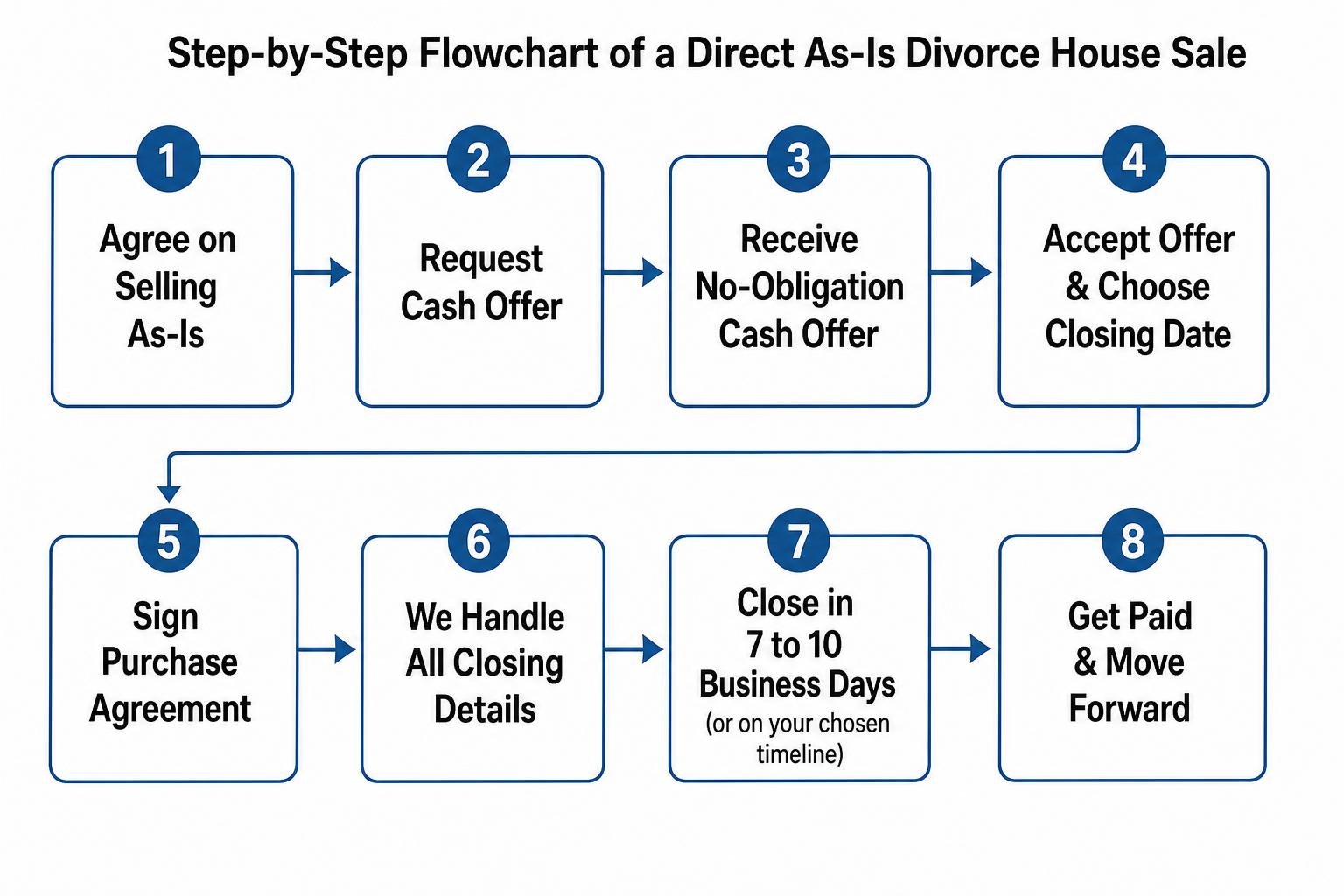
Furthermore, there are no yard signs broadcasting your personal family transition to neighbors, and there is no public listing of any kind. You pay no commissions, and you are not asked to clear out unwanted furniture or personal belongings before leaving. We take pride in how we help homeowners find practical, pressure-free options during difficult life transitions.
Step-by-Step Guide: Navigating Legal and Financial Requirements
Successfully completing an as-is sale during a divorce requires following clear legal and administrative steps to ensure title clarity and compliance with family court rules.

Step 1: Clarify Title Ownership and Marital Status
Before entering into any sales contract, determine how the property is titled. If both spouses appear on the deed as joint tenants or tenants by the entirety, both must consent to the transaction and sign the conveyance documents. If only one spouse is on the title but the home was acquired or appreciated during the marriage, the non-titled spouse often retains marital equity rights under state equitable distribution laws.
Step 2: Secure Attorney and Court Clearance
Ensure that listing or selling the property does not violate standing court injunctions. Provide your respective family law attorneys with the written cash purchase agreement. Once both legal teams confirm that the terms protect their clients’ financial interests, they will draft the appropriate stipulations or submit the contract for judicial sign-off if required.
Step 3: Clear Mortgages and Encumbrances
The closing title company or closing attorney will order an official payoff statement from your current mortgage lender, along with title searches to identify any tax liens, mechanics’ liens, or secondary financing. All existing debt secured by the property is paid off directly from the gross sales proceeds at the closing table before any remaining equity is distributed.
Handling Spousal Disagreements and Court-Ordered Sales
What happens when one spouse wants to sell the property to achieve financial freedom, but the other refuses to cooperate?
When mutual agreement cannot be reached, the spouse seeking to liquidate can petition the family court judge for relief. In contentious situations, a judge can order the marital home sold and appoint a court receiver, special magistrate, or partition referee to oversee the disposition. The court can authorize the transaction even over the objection of an uncooperative partner, ensuring that marital equity is preserved rather than drained away by ongoing mortgage defaults or foreclosure proceedings.
When facing tight court deadlines, having ready options to sell home fast allows both parties to present a viable, guaranteed exit strategy to the judge rather than risking prolonged delays or financial loss.
Remote Closings and Proceeds Distribution
Divorcing spouses rarely want to sit across the same table at a closing office. Fortunately, modern real estate procedures eliminate that requirement entirely.
Closing title companies can easily coordinate separate signing appointments or dispatch mobile notaries directly to each spouse at their respective residence or office. Spouses can sign closing documents at completely different times and locations across Northeast Florida—whether in Jacksonville, Jacksonville Beach, Atlantic Beach, Neptune Beach, Ponte Vedra, Ponte Vedra Beach, St. Augustine, St. Augustine Beach, Orange Park, Fleming Island, or Middleburg.

Once documents are executed and funds are received, the neutral closing agent disburses the net proceeds directly into separate bank accounts according to the marital settlement agreement or final divorce decree.
You can see a real-world example of this streamlined process in our recent transaction review of a Mandarin Jacksonville FL house divorce property sold as is for cash with a quick closing.
Understanding Key Tax Protections: IRC §1041 and IRC §121
When dividing real estate equity in a divorce, two federal tax provisions provide essential financial relief:
- IRC §1041 (Tax-Free Transfers Incident to Divorce): Under Internal Revenue Code Section 1041, transfers of property between spouses—or former spouses if incident to a divorce—are generally non-taxable. No gain or loss is recognized on the transfer itself, and the receiving spouse assumes the adjusted basis of the property.
- IRC §121 (Primary Residence Capital Gains Exclusion): When the home is sold to an outside buyer, single taxpayers can exclude up to $250,000 of capital gain from their taxable income, while married couples filing jointly can exclude up to $500,000, provided they have owned and used the property as their principal residence for at least two out of the five years preceding the sale. Even if one spouse moved out due to the separation, special tax provisions often allow that spouse to claim the exclusion if the other spouse continued to live in the home under a divorce decree.
Frequently Asked Questions about Divorce House Sales
Can a family court judge force us to sell our house in a divorce?
Yes. If spouses cannot agree on how to handle the marital residence, the family court has the full authority to order the sale of the property. The court can order the property liquidated under equitable distribution principles and mandate that net equity be divided fairly after mortgage balances, closing costs, and court-approved credits are satisfied.
How are home sale proceeds and capital gains taxes split after closing?
Net proceeds are determined by taking the gross sale price and subtracting existing mortgage payoffs, property tax prorations, title closing fees, and any agreed-upon lien settlements. The remaining funds are held in a neutral escrow account and disbursed according to your marital settlement agreement or final court decree. Capital gains taxes only apply if the net profit exceeds the primary residence exclusion limits under IRC §121 ($250,000 for single filers or $500,000 for married couples filing jointly).
What is a deferred sale of home order?
A deferred sale of home order (sometimes referred to as a “Duke order” in family law) is a judicial decree that temporarily delays the sale of the family residence. This order grants exclusive occupancy of the home to the custodial parent for a specific duration—such as until minor children reach graduation age or until a set future date. Once the specified term expires, the property is sold directly to an as-is buyer, and the resulting equity is divided between both former spouses.
For answers to other common questions regarding property sales and transactions, visit our complete frequently asked questions page.
Conclusion
Divorce is challenging, but selling your shared real estate asset does not have to become an endless battleground of repair estimates, contractor delays, and financial stress. Opting for an as-is cash sale provides an immediate, clean, and dignified resolution.
At Full Circle Homes, we are a family-owned cash home buyer based right here in Jacksonville, Florida. We work directly with homeowners across Duval, St. Johns, and Clay counties, offering fair cash prices for properties in any condition. There are no commissions, no hidden administrative fees, and absolutely no repair requirements. We coordinate smoothly with your closing attorneys, arrange flexible, remote signing appointments, and allow you to close on the timeline that works best for your situation.
If you are ready to make a clean financial break and avoid costly pre-sale repair disputes, reach out to our team at Full Circle Home Buyer today to receive a straightforward, no-obligation cash offer on your property.